Showing posts with label comics. Show all posts

Thursday, June 18, 2026

The Insult That Made a Killer Out of Sarva


Cover of Plogg #2 (November 1997)

“The Insult That Made a Killer Out of Sarva” appeared in the second issue (November 1997) of my small press comic, Plogg. It was the first of four appearances for Sarva and I hadn’t hit my stride yet with the character, so I’m a bit ambivalent about the results. I was using a different style and approach, somewhat cartoonish, simpler and less detailed, as my previous issue featuring May the Hyperborean had been. Also, I had grown up on superhero comics (as well as science fiction, monsters and fantasy) -- a far cry from the Sarva stories, which parodied the blaxploitation movies of the 1970s, so I was out of my element depicting a particularly rough neighbourhood known as “Hell’s Bathroom”.

A few readers wondered if Sarva was a prostitute. She wasn’t, and I was baffled by the question, since I didn’t even hint at anything of the sort. Perhaps it was the way she dressed, or the fact that the villain of the story, Pluto, called her “ho” on page two, first panel. He was simply hurling insults, a bully with a crass and limited vocabulary.

Sarva’s various speech patterns are affected, employed only when dealing with some of the characters she runs into, communicating on their own level. Otherwise, she’s far more articulate than the denizens of Hell’s Bathroom.

Of course, the basic plot follows that of the familiar Charles Atlas bodybuilding ad, “The Insult That Made a Man Out of Mac”, although Sarva’s revenge on the bully is a little more final than Mac’s fist in the face.

The Sarva stories were preposterous, as they were meant to be. The situations are absurd and the characters are grossly exaggerated caricatures. The slapstick violence is straight out of a Warner Bros. cartoon, and reactions to any bloodshed are either comic or apathetic. It’s no less fantastic and unrealistic than any superhero comic.

Shortly after publishing Plogg #2, I sent photocopies of “The Insult That Made a Killer Out of Sarva” to Players (a magazine geared towards black men, often compared to Playboy) for their consideration. I had one-panel gag cartoons printed in their magazine on two prior occasions, and tried to convince them that they needed a comics section. Well, it worked, but only for two issues. They serialised the Sarva comic in three-page installments before cancelling it halfway through the story. (It appeared in the February and March 1998 issues of Players.) It’s too bad. It was beautifully printed on thick, glossy paper, and I had spoken to the editor-in-chief on the phone. He was enthusiastic and wanted me to continue the series (I was already working on the next Sarva tale), which he hoped I would do in colour.

What went wrong? I’m not sure. The issue containing the first installment of the story devoted most of the editorial to it, part of which read “the writer, designer, artist, and conceptualist’s name is Richard Beland. Now, Richard is a brother…”

The editor surmised I was black, and I felt it would be unfair and dishonest to let him continue harbouring that assumption, so I called him immediately to correct him. He was surprised to learn that I wasn’t black, but he seemed to think it was inconsequential. We had a long conversation, mostly about the future of the series. However, after the second installment, I was given a contributor’s copy -- as well as a pink slip! It was a form letter, not addressing me by name but as “Dear contributor”, wishing me “good luck in all my endeavors.” I called the editor for an explanation, but he had no time to talk and merely wished me rotsa ruck publishing the Sarva stories elsewhere.

Perhaps the publisher felt that the magazine should be devoted exclusively to black voices. Perhaps they felt that Sarva’s pugilistic, pugnacious personality, and certainly her sometimes lethal methods of dealing with criminals was too violent (and gory), and not in keeping with the magazine’s values. Then again, it could be that the crass parodies of Archie Andrews (“Alfred E. Andrews”) and Jughead Jones (“Crackhead Jones”) were a lawsuit waiting to happen, though it’s doubtful that the publisher of Archie Comics even noticed.  Players folded in 2005.

If you’re curious about the name “Sarva”: While this story was a work in progress, I was having trouble coming up with a unique name; then one day I glanced at a record album leaning against the wall on the very desk I was working at -- a Sarah Vaughan record!

And now, without further ado (or adon’t), a comic that’s been mouldering for 29 years (as the crow flies)...


Insult pg1

Insult pg2

Insult pg3

Insult pg4

Insult pg5

Insult pg6

Insult pg7

Insult pg8

Insult pg9

Insult pg10

Insult pg11

Insult pg12


Tuesday, April 15, 2025

Meddle and Gretel

Meddle and Gretel (2009) was drawn in felt tip pen on thick 9" x 12" paper. It was meant to be dreamlike. Each line of Meddle's nonsensical mumbling on page 7 came from a different dream, written down on a piece of paper kept at my bedside.

Meddle and Gretel pg1


Meddle and Gretel pg2

Meddle and Gretel pg3


Meddle and Gretel pg4

Meddle and Gretel pg5

Meddle and Gretel pg6

Meddle and Gretel pg7


Saturday, April 05, 2025

Funk Rage

"Funk Rage", the third in the Sarva series, was featured in my small press comic, PLOGG #4 (November 2001).  In part, it was a parody of Marvel's Luke Cage character, who exploded on the scene early in 1972 in HERO FOR HIRE, during the height of the Blaxploitation genre.  Carl Lucas acquired bulletproof skin and super strength after participating in a scientific experiment gone haywire while in prison.  Taking advantage of these unexpected abilities, he smashes his way through a brick wall, and the escaped convict sets up his own business in New York City's Times Square district as a "Hero for Hire", under the assumed name of Luke Cage.  His office is above a repertory cinema, The Gem, operated by a young fella who went by the name "D.W.", after the famous director, D.W. Griffith.

For some reason the delirious powers that be gave the magazine a ridiculous new title, POWER MAN, with issue #17.  Why any person with a shred of dignity would walk around calling themselves "Power Man" is beyond me.  But one person really took umbrage at Cage's new moniker, a villain of the same name, who'd menaced the Avengers back in the '60s.  In POWER MAN #21, the villain challenges Cage over the right to the name.  Cage rearranges the poor fool's face -- destroying the Gem theatre for the umpteenth time in the process -- and on the last page of the story delivers a caution to his former namesake before he slips into unconsciousness:

"You can call yourself Spider-Man...you can call yourself the Invisible Girl...you can stick a flag in your navel and call yourself the Spirit of '76...but if you ever call yourself Power Man again...I will tattoo that name on your rib cage!"

The last page of "Funk Rage" was directly inspired by that little scene.

"Supermangle", a parody of a public service included in DC comics of the 1960s, appeared in PLOGG #3 (October 1998).

(See here for the 4th and last comic in the Sarva series, as well as a brief description of the character.)

Funk Rage page 1

 
Funk Rage page 2

Funk Rage page 3

Funk Rage page 4

Funk Rage page 5


Funk Rage page 6


Funk Rage page 7


Funk Rage page 8


Funk Rage page 9


Funk Rage page 10


Funk Rage page 11


Funk Rage page 12


Funk Rage page 13


Supermangle


Friday, December 09, 2022

The Hip Horrors


The Hip Horrors first appeared in a short story titled "Animal Friends", in HIP HORROR COMICS, one of my hundreds of home made comic books, in 1982, but which I cover-dated June 1968.

I was always a fan of horror movies, especially the Universal horrors of the 1930s and 1940s.  I also liked Roger Corman's productions of the 1960s, and anything with Vincent Price in it.  But I also really liked the mixture of horror and humour, such as the classic ABBOTT AND COSTELLO MEET FRANKENSTEIN, or the Bowery Boys, when they found themselves in haunted houses, and Corman's THE RAVEN, with Vincent Price, Peter Lorre and Boris Karloff, who also starred in another horror spoof, THE COMEDY OF TERRORS.  Every week I watched the monotonous but entertaining HILARIOUS HOUSE OF FRIGHTENSTEIN.  The list goes on.

I also bought Stan Lee's MONSTER MADNESS, and collected the "You'll Die Laughing" bubble gum cards, circa 1973.

The Hip Horrors are a quartet of London hippies whose favourite hangout is a nightclub called the Ganymede Spectrum Sanctuary.  They also take it upon themselves to battle vampires, werewolves, zombies and other supernatural creatures that cross their paths.  The group consists of Mary Jane Jones, the brains of the bunch, and perhaps the most fearless; Carl Caine, calm and rational, the voice of reason; John Bedford, a Jughead Jones-type character, who is often found sleeping or eating, and is somewhat indifferent to monster hunting; and Jim Spencer, a gravedigger by profession, who is cowardly and would rather steer clear of monsters, but is the toughest member, and won't back down if the fight is brought to him.

The following 10-page story, "He Was A Middle-Age Vampire", was extemporaneously written and drawn in pencil on 8.5" x 11" sheets of paper folded in half (as was HIP HORROR COMICS), probably in 1983.

Hip Horrors pg1

Hip Horrors pg2

Hip Horrors pg3

Hip Horrors pg4

Hip Horrors pg5

Hip Horrors pg6

Hip Horrors pg7

Hip Horrors pg8

Hip Horrors pg9

Hip Horrors pg10


Wednesday, March 30, 2022

Animation


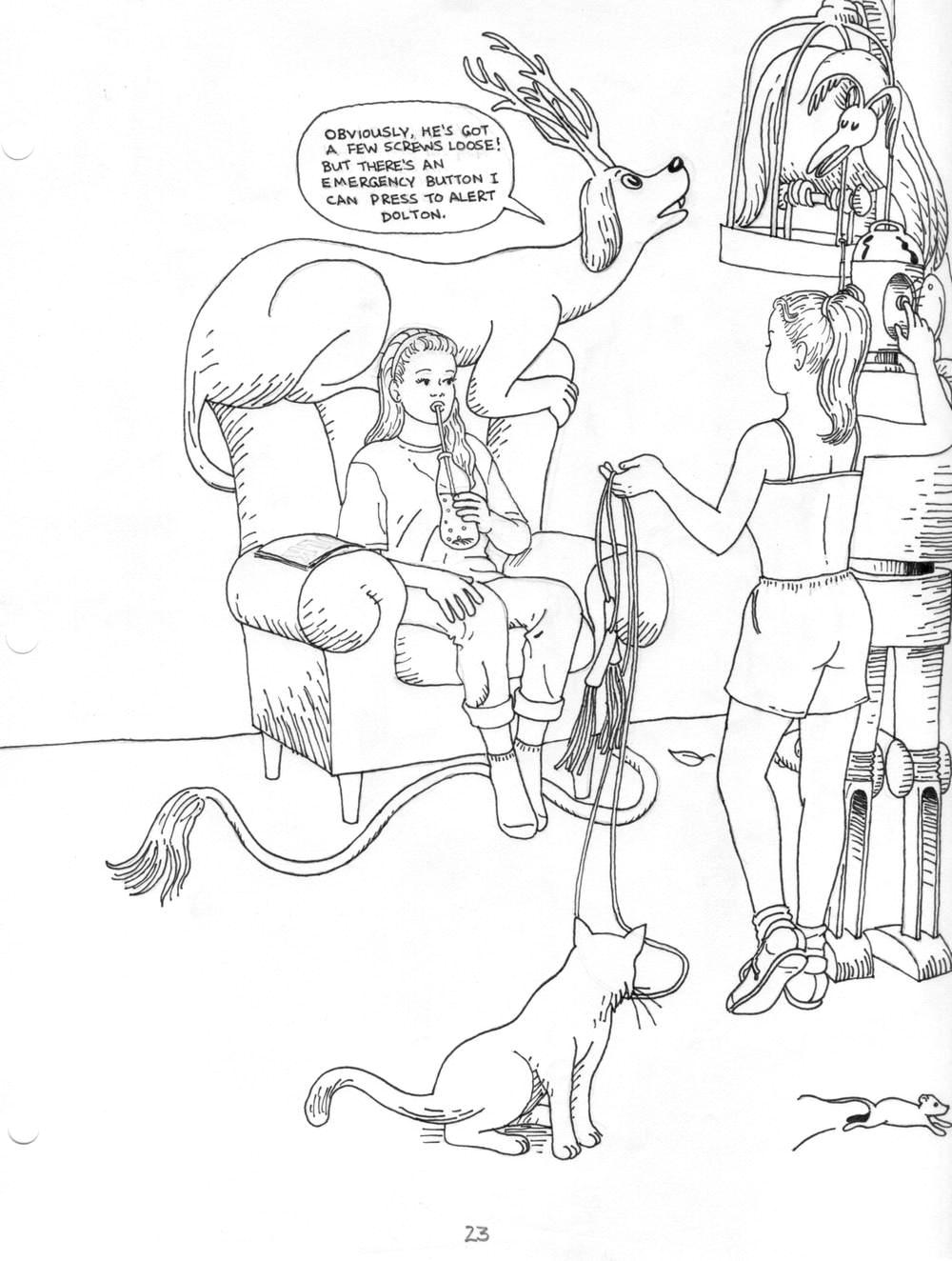
Originally, the young girl featured in this 40-page comic was to be May the Hyperborean, whose only previous appearance was in 1990, in a piece of pulse-pounding prose titled "The Story of May", slightly revised in 1999 as "Nightmare in Metal".  May's dog, Digger, was perched on top of the armchair.  I'd hardly begun when, for some reason, I changed the character from May to that of "Betty Copper", simply by adding proper clothing over May's jungle girl-type bikini, and the whole story became a dream-like allusion to characters from Archie comics.

Betty Copper is, of course, Betty Cooper.  Both girls being blonde, I didn't have to change a single hair on May's head.  The gorilla is Big Moose, whose last name is Mason, hence the jar he was looking for.  Gilda Golde is none other than Veronica Lodge, Betty's wealthy best friend (and worst rival).  Gilda's subservient robot is Archie Andrews.  Dolton is the boy genius, Dilton Doiley.  Jawbone is seen stuffing his face with a sandwich, a favourite pastime for his counterpart, Jughead Jones.  Jawbone makes a passing reference to "Dismantle", who sabotaged the robot, just as Reggie Mantle always does his best to upset Archie's plans, or otherwise ruin his day.

When the forty pages are in a file on a computer and clicked through, they seem to move like an animated cartoon.  The story ends where it began, with Betty being bored.  The only difference between the first and last page is the bottle of pop: Betty sips it throughout the story, leaving it empty on the last page.

May the Hyperborean did finally make her comic book debut in PLOGG #1 (August 1994).

Animation Page 1

Animation Page 2

Animation Page 3

Animation Page 4

Animation Page 5

Animation Page 6

Animation Page 7

Animation Page 8

Animation Page 9

Animation Page 10

Animation Page 11

Animation Page 12

Animation Page 13

Animation Page 14

Animation Page 15

Animation Page 16

Animation Page 17

Animation Page 18

Animation Page 19

Animation Page 20

Animation Page 21

Animation Page 22

Animation Page 23

Animation Page 24

Animation Page 25

Animation Page 26

Animation Page 27

Animation Page 28

Animation Page 29

Animation Page 30

Animation Page 31

Animation Page 32

Animation Page 33

Animation Page 34

Animation Page 35

Animation Page 36

Animation Page 37

Animation Page 38

Animation Page 39

Animation Page 40